Gharial (Gavialis gangeticus)
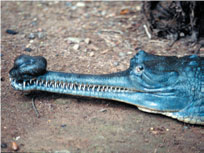
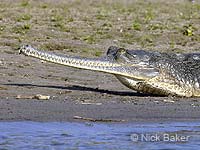 Gavialis gangeticus, the Gharial, is a member of the subfamily Gavialinae. Other than its long snout, its most unusual and distinctive feature is the bulbous protuberance on the snout of adult males. It is from this structure that the word Gharial originated - from the Hindu "ghara" meaning "pot". The species is sometimes called a "gavial", but this is incorrect and the use of that name has been largely abandoned.
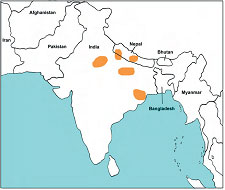
Gharials occurred historically in India, Pakistan, Myanmar, Bhutan and Nepal, where they inhabited rivers and hill streams. However, due to the pressures of an enormous human population, loss of habitat and hunting for skins, the Gharial populations declined in numbers. Today, wild populations exist in India (Chambal, Son, Ken and Mahanadi Rivers; Katerniaghat Wildlife Sanctuary) and Nepal (Rapti-Narayani, Karnali, Babai and Koshi Rivers).
 Successful restocking programs in India and Nepal saw wild Gharial populations increase, but over the last 10 years the wild populations have again declined, as a result of various factors (eg netting, habitat alteration). As a consequence, the species was recently (2007) listed as “Critically Endangered” on the IUCN Red List of Threatened Species [link to http://www.iucnredlist.org/], and the global wild population is estimated to contain less than 2000 adults (most originating from restocking programs). To ensure the species’ survival, breeding facilities in India and Nepal have been established.
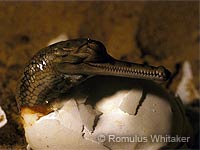
Mating occurs in December-January, and nesting in March-April. Females lay an average of 40 eggs (range 6-95) in a hole nest in sandy substrates on mid-river sandbars and river banks. Known predators on the nests are rats and jackals, and wild pigs and monitor lizards are also suspected.
 Male Gharials mature at about 3 m total length (males at around 13 years of age, females about 16 years), and some may grow to large sizes (eg exceeding 6 m). Fish appear to be the main food, although they eat insects, frogs and a variety of other small animals.

 Email CSG